Plan Your SIPREC Device Hierarchy Structure
Managing device-based call recording involves three key components:
|
■
|
Devices — the endpoints whose calls you intend to record. |
|
■
|
Device Groups — logical containers that organize devices and serve as the link between those devices and their assigned device recording profile. |
|
■
|
Device Recording Profiles — configurations that define how calls are recorded, including call direction, retention period, and storage location. |
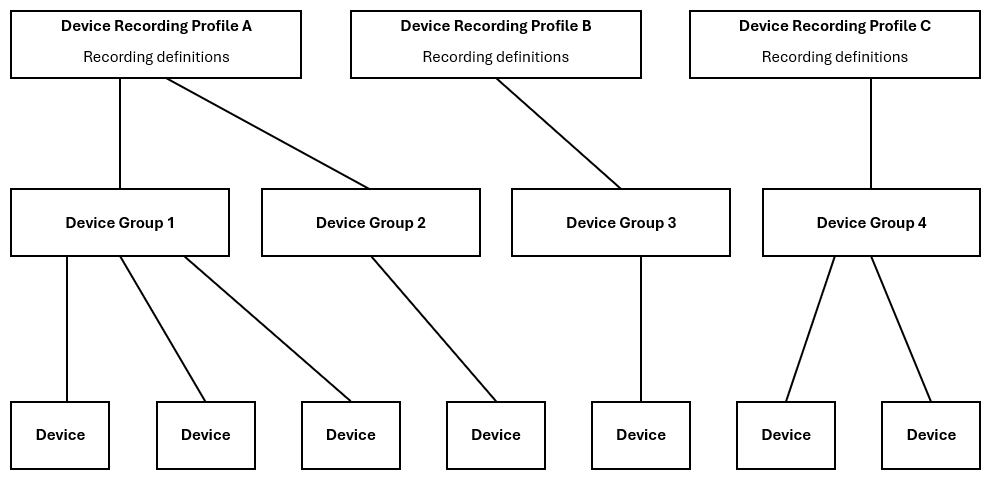
Together, these elements determine which devices are recorded and what recording rules apply to them. The profile defines the recording rules; the devicegroup determines which devices inherit them.
A device recording profile can be assigned to multiple device groups, but a device group can be mapped to a single device recording profile only.
|
➢
|
To plan your device recording hierarchy structure: |
|
1.
|
Compile an inventory of all devices that require recording. |
|
2.
|
Determine the recording requirements of these devices. For example: |
|
●
|
One set of devices may require only incoming calls to be recorded, with data retained for one month at Storage Location A. |
|
●
|
Another set may require all calls to be recorded, with retention set to one year at Storage Location B. |
|
3.
|
Decide how to logically group the devices. Grouping can be based on location, department, function, or any structure that aligns with your operational model. |
The following is a schematic example of a SIPREC device hierarchy structure:
|
➢
|
Once you have made the above decisions, you can set up device recording: |
|
1.
|
For each logical group, create a device group (unless the group already exists). If a group contains devices that require different recording settings, you must create separate groups for each setting.
|
|
2.
|
For each set of recording requirements, create a device recording profile and map it to the corresponding device group or groups. |
|
3.
|
Add or update devices and map each to the appropriate device group. |
See also: